SMART TD Comments on FRA Crew Size Rule

 Click To View Documents: SMART TD BLET Joint Comments FRA20140033.pdf (677KB)6.16.16 SMART-TD_BLET 2 person crew comments press statement.pdf (244KB);
Dear Brothers and Sisters:

Yesterday, the SMART Transportation Division and the Brotherhood of Locomotive Engineers and Trainmen (BLET) filed joint comments on the Federal Railroad Administration's (FRA) Notice of Proposed Rulemaking (NPRM) on train crew staffing. In our comments, we emphasized the critical safety importance of requiring a crew of at least two individuals - a certified conductor and a certified engineer - on all freight trains and asked the FRA to strengthen its rule by closing dangerous loopholes that would lead to increased single-person train operations.

Attached you will find copies of our joint comments on the NPRM and a press release. The press release can also be viewed by following this link.

We would also like to extend our thanks to all SMART TD members who submitted comments of their own.

In Solidarity,
                           
John Previsich                                     John Risch President                                              National Legislative Director SMART Transportation Division        SMART Transportation Division

ALERT--ALERT--The Countdown is ON!

Federal Railroad Administration-Train Crew Staffing Rule...

The FRA extended the open comment period to June 15th. We only have 9 days left to FILE COMMENTS Supporting the FRA's Proposed Rule of 2 Person Crews!
 
Share your Story !! 
The most effective thing you can include in your comments is a personal story of how having two people on your crew prevented an accident from happening. It is not necessary to include all the details like train numbers or dates; just an overview of the incident and how having the second crew member made a difference. Examples of how the second crew member cleared a blocked crossing for an emergency vehicle or dealt with emergency responders during a derailment would also be very beneficial.
No one can make a stronger case for two-person crews than those who work - or have worked - on the front lines operating trains every day.
The deadline is June 15th!

Oregon train derailment spills oil, sparks fire

A Union Pacific train carrying a volatile type of oil derailed in Oregon's scenic Columbia River Gorge

Associated Press  By Gillian Flaccus, Associated Press
 Oregon train derailment spills oil, sparks fire
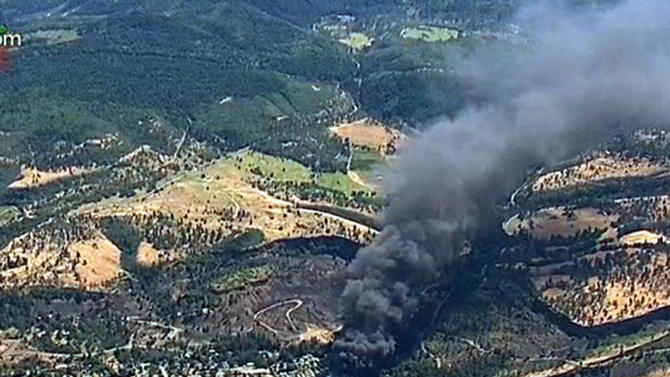
View photo: In this frame from video provided by KGW-TV, smoke billows from a Union Pacific train that derailed Friday, June 3, 2016 in Oregon's scenic Columbia River Gorge. The accident sparked a fire and an oil spill near the Columbia River. No injuries were reported. (KGW-TV via AP)
PORTLAND, Ore. (AP) -- A train towing a highly volatile type of oil derailed Friday in Oregon's scenic Columbia River Gorge, igniting a fire that sent a plume of black smoke into the sky and spurring evacuations and road closures.

Eleven cars derailed Friday in the 96-car Union Pacific train and the railroad said several caught fire. The crash released oil alongside tracks that parallel the Columbia River.

All the cars on the train traveling to Tacoma, Washington, from Eastpoint, Idaho, were carrying Bakken oil, which is more flammable than other varieties because it has a higher gas content and vapor pressure and lower flash point.

The accident immediately drew reaction from environmentalists who said oil should not be transported by rail, particularly along a river that is a hub of recreation and commerce.

"Moving oil by rail constantly puts our communities and environment at risk," said Jared Margolis, an attorney at the Center for Biological Diversity in Eugene, Oregon.

It wasn't immediately clear if oil had seeped into the river or what had caused the derailment. No injuries were reported.

Aaron Hunt, a spokesman for the railroad, did not know how fast the train was traveling at the time, but witnesses said it was going slowly as it passed the town of Mosier, Oregon, about 70 miles east of Portland.

Response teams were using a drone to assess the damage, said Katherine Santini, a spokeswoman with the U.S. Forest Service. Crews were working to suppress the fire, which they expected to continue doing into the night.

Officials in Mosier closed about 23 miles of Interstate 84 and evacuated a half-mile radius around the spill, including 200 school children who were later picked up by their parents and 50 homes in a mobile home park.

Silas Bleakley was working at his restaurant in Mosier when the train derailed.

"You could feel it through the ground. It was more of a feeling than a noise," he told The Associated Press as smoke billowed from the tankers.

Bleakley said he went outside, saw the smoke and got in his truck and drove about 2,000 feet to a bridge that crosses the railroad tracks.

There, he said he saw tanker cars "accordioned" across the tracks.

Another witness, Brian Shurton, was watching the train as it passed by the town when he heard a tremendous noise.

"All of a sudden, I heard 'Bang! Bang! Bang!' like dominoes," he told The Associated Press.

He also drove to the overpass and saw the cars flipped over before a fire started and he called 911.

"The train wasn't going very fast. It would have been worse if it had been faster," said Shurton, who runs a wind surfing business in nearby Hood River.

Matt Lehner, a spokesman from the Federal Railroad Administration, said a team of investigators had arrived at the scene from Vancouver, Washington.

Union Pacific said 11 cars had derailed, but a spokesman from the Oregon Department of Forestry, which helped extinguish the blaze, said 12 cars had been involved. The discrepancy could not immediately be resolved.

Including Friday's accident, at least 26 oil trains have been involved in major fires or derailments during the past decade in the U.S. and Canada, according to Associated Press analysis of accident records from the two countries.

The worst was a 2013 derailment that killed 47 people in Lac-Megantic, Quebec. Damage from that accident has been estimated at $1.2 billion or higher.

At least 12 of the oil trains that derailed were carrying crude from the Northern Plains' Bakken region — fuel that is known for being highly volatile. Of those, eight resulted in fires.

Since last spring, North Dakota regulators have required companies to treat oil before it's shipped by rail to make it less combustible.

A May 2015 derailment near Heimdal, North Dakota, involved cars carrying oil that had been treated to reduce the volatility, but the crude still ignited. At least one train wreck involving treated Bakken oil did not result in a fire, when 22 cars derailed and 35,000 gallons of oil spilled near Culbertson, Montana, last July.

Reducing the explosiveness of the crude moved by rail was not supposed to be a cure-all to prevent accidents. Department of Transportation rules imposed last year require companies to use stronger tank cars that are better able to withstand derailments.

But tens of thousands of outdated tank cars that are prone to split open during accidents remain in use.

It's expected to take years for them to be retrofitted or replaced.

Hunt, the Union Pacific spokesman, did not respond to questions about whether the Bakken oil in Friday's derailment had been treated to reduce volatility. It also wasn't clear if the tank cars in the accident had been retrofitted under the new rules.

To get to refineries on the East and West coasts and the Gulf of Mexico, oil trains move through more than 400 counties, including major metropolitan areas such as Philadelphia; Seattle; Chicago; Newark, New Jersey; and dozens of other cities, according to railroad disclosures filed with regulators.

__

Associated Press Writers Matthew Brown in Billings, Montana; Steven Dubois in Portland, Oregon and Alina Hartounian in Phoenix contributed to this report.

We need your comments on 2-person crews -Deadline extended to June 15

We need your comments on 2-person crews -Deadline extended to June 15 On March 15th, the Federal Railroad Administration (FRA) issued a long overdue proposed regulation requiring that most trains in America have a minimum of two crewmembers. While SMART TD supports the core requirements of the rule, we believe that it can be strengthened and improved before this proposed regulation becomes final. We also expect the railroads to do everything in their power to weaken the rule. That is why we need your help.

As a railroad worker, you have firsthand knowledge of the importance of two-person crews and the dangers of single-person operations. That is why the FRA needs to hear your voice on this critical safety issue. Please follow this link to submit your own comments on the rule, citing your personal experiences and expertise in operating trains.

The most effective thing you can include in your comments is a personal story of how having two people on your crew prevented an accident from happening. It is not necessary to include all the details like train numbers or dates; just an overview of the incident and how having the second crew member made a difference. Examples of how the second crew member cleared a blocked crossing for an emergency vehicle or dealt with emergency responders during a derailment would also be very beneficial.

No one can make a stronger case for two-person crews than those who work — or have worked — on the front lines operating trains every day.

The deadline for comments has been extended to June 15, 2016 – more time to get your co-workers, friends, family members and community leaders to comment!

Thank you for your help with this critically important issue.

Below is an excellent example of a comment submitted by retired member Daniel Potaracke from Wisconsin:

Agency: Federal Railroad Administration (FRA) Document Type: Rulemaking Title: Train Crew Staffing Document ID: FRA-2014-0033-0001

Thank You for this opportunity to comment on this important issue.

I started on the BNSF RR in 1972 and retired in 2013 after 42 years of service. In 1972, I was one of 5 crew members on a train. When I retired, there were just 2 people on a train, the engineer and I the conductor. I’ve seen lots of changes on the railroad and that is putting it very mildly. With all the technology, you would think it would be safer but, I believe it has actually gotten less safe for a number of reasons. The railroads went from handling and hauling basic cargo and smaller trains to now handling much bigger trains with lots more dangerous cargo in increasing amounts. I remember having “a few” dangerous shipments but, when I retired, I was responsible for having LOTS of dangerous and hazardous cargoes. Just before I retired, I had to sift through lots and lots of paperwork to make sure I had ALL the information and redundancy so if there was a problem, I had some solutions for emergency workers and whomever needed it. I’m not saying it is bad but, making sure I had the paperwork and having someone else to count on made it somewhat better; and, how else are shippers going to transport these dangerous cargoes other than the nations highways? From what I’ve read about the trucking industry, with one person driving a huge truck with dangerous materials and the fatigue the truck drivers put up with, I’m amazed there aren’t more crashes. Having 2 people on a train is definitely much more safe!

Having two sets of eyes and ears on the front end of ALL trains is essential for safety for everyone including the public, the employees and the railroads themselves. As a retired BNSF RR conductor, I’ve personally witnessed many “emergency” type incidents that warranted immediate attention and I’m not at all sure that they would have been caught by just one person. Splitting duties in such a way that there are two people onboard makes it easier for one of them to catch a problem vs having one person having so many things to be aware of and all at the same time. I know from personal experience that I’ve averted a few derailments or possible derailments because I’ve caught a problem on either my train or another passing train be it sticking brakes, cracked wheels or hot bearings and shifted loads or other problems.

As you know, the railroads carry so many commodities that are very hazardous including oil trains that will burn out of control for days at a time, nuclear waste, chemicals that are certain death with contact or inhalation and munitions and explosives. Having two people on a train can catch a problem before a derailment with any of the above cargoes in a city or even out in the country where winds can blow dangerous inhalations to a city or town. Imagine a burning and exploding oil train in a congested city as big as Chicago or Minneapolis or even a small town where the entire population could be wiped out! We have all seen the images of burning oil trains; now imagine that in the middle of a city with populations living within a few hundred feet!

I sometimes wonder if the railroad companies are like the automobile companies that work out the risks or odds of a derailment or toxic release or something similar where they cross their fingers and hope nothing happens but, if something did happen, the chances are 1 in X amount of percent, they could live with that and the resulting monetary damages…or deaths…or whatever.

Please keep America safe with the railroads running safe with two people!

Rail Members – Your Comments on 2-Person Crews are Needed!

Dear Member, On March 15th, the Federal Railroad Administration (FRA) issued a long overdue proposed regulation requiring that most trains in America have a minimum of two crewmembers. The proposed rule is a step in the right direction but as written it falls short of what SMART TD believes is necessary to ensure the safe operation of all of our nation’s trains. The proposed regulation is currently in the comment period and the deadline to submit comments to the FRA on why it is absolutely necessary to have at least two crew members on every train, is May 16.

From working with officials at the FRA, to meeting with federal and state legislative leaders, SMART TD’s long campaign to bring about this critical rail safety reform continues, and can only be successful with your voice! The railroads are doing everything in their power to weaken the rule, but your comments are more powerful than the rail industry and will make an impact!

As a railroad worker, you have firsthand knowledge of the importance of two-person crews and the dangers of single-person operations. That is why the FRA needs to hear your voice on this critical safety issue.

Please click on the following link to submit your own comments on the rule, citing your personal experiences and expertise in operating trains:

https://www.regulations.gov/#!submitComment;D=FRA-2014-0033-0001

No one can make a stronger case for two-person crews than those who work — or have worked — on the front lines operating trains every day.

Again, the deadline for comments is May 16, 2016 so please submit your comments now!

Thank you for your help with this critically important issue.

Sincerely,

John Previsich President, SMART Transportation Division

FRA rule gives us chance to bar most one-person crew trains

By John Previsich and Ed Wytkind

The freight railroads would have the public believe that operating massive freight trains with a single crew member is perfectly safe. We know those claims are not true and fortunately so does our government which just issued proposed regulations establishing a two-person crew minimum on most trains. We applaud those rules and will push to make them as tough and rigid as possible.

If former Senator Daniel Patrick Moynihan was alive today, he would probably tell the railroads, “you’re entitled to your opinion, but not your own facts.” Despite erroneous claims by the industry lobby that there is a lack of “conclusive statistical data” to support a two-person crew standard, we know from data gleaned from reports on accidents, crashes and fatalities as well as the real-life experiences of frontline employees, that the arguments in favor of a two-person crew standard are compelling.

The railroads rely on skewed statistical analysis to argue that a lack of accidents from the use of one-person crews means that this two-person train crew rule isn’t needed. The reality is that almost all trains in America operate with two crew members and thankfully, one-person crew operations are still the rare exception. Of course there is not a great deal of data available. More to the point, the safety statistics in today’s industry are a product of the skill and professionalism of the two-person and three-person crews that operate trains across America today.

Federal regulators’ own research underscores the necessity of having at a minimum a federally certified engineer and a federally certified conductor on trains. These employees support each other’s decision-making process. They work together to combat fatigue, especially in the real-world of train crews defined by mandated long shifts and unpredictable work schedules. They support safe operations in the event of emergencies or if one of the crew members becomes incapacitated, a fact that is also recognized by the Federal Aviation Administration as it prohibits cockpit crews of fewer than two pilots.

Conveniently, the railroads also fail to mention what happened three years ago in the Quebec town of Lac-Megantic. A runaway train carrying 72 cars of crude oil killed 47 people and leveled most of the town. This train was under the control of a single crew member who failed to properly secure the train (because he lacked a co-crew member to assist and support him) ending in a fiery and deadly crash.

The industry’s assertion that mandates to implement Positive Train Control (PTC) technology in the rail industry are somehow in conflict with the FRA’s crew size rule is absurd. In case facts matter, PTC is simply one more redundant safety tool in rail operations that requires a great deal of train crew interaction in order for it to work. In fact, a fully operational PTC system puts more demands on the attention of the crew because of the distractions it causes. While advancement in transportation technology can provide essential safety support and save lives, it is not, and never will be, a replacement for highly trained, experienced and adequately staffed crews.

By the way, the public has spoken loudly on the subject. In states across America, both red and blue, an overwhelming majority of Americans strongly support a two-person train crew standard. The numbers are consistently strong cross all political and ideological lines with up to 91 percent of Democrats and 82 percent of Republicans favoring federal action to bar one-person train operations.

The safety arguments support a two-person crew standard. The public supports a two-person crew standard. Now it is time for our government to bar most one-person train operations.

Previsich jprevisich@smart-union.org is president of SMART Transportation Division and Wytkind edw@ttd.org is president of theTransportation Trades Department, AFL-CIO.

Amtrak Train Crash Leaves 2 Dead, Officials Say

imgres

CHESTER, Pa. — An Amtrak train, southbound at high speed on Sunday morning, slammed into construction equipment on the tracks near Philadelphia, killing two track workers and wounding more than 30 passengers, the authorities said.

A team of investigators from the National Transportation Safety Board arrived at the scene on Sunday afternoon to determine why the equipment, a backhoe, was on an active track. The backhoe was struck by Amtrak’s Train 89, known as the Palmetto, which left New York City on schedule about 6 a.m., bound for Savannah, Ga.

Passengers said the train was hurtling along with no sign of trouble before the sound of a crash, followed by a shuddering deceleration. The crash left the front of the engine crumpled, its windshield shattered and riders in the front two cars thrown to the floor.

“The direct impact was big,” said Adriene Hobdy, a passenger. “It was terrible, absolutely terrible. All you felt was boom, boom, boom, boom. Our windows flew out.”

The crash disrupted train service between New York City and Wilmington, Del., for much of the day, but Amtrak was working to restore service in time for the Monday morning commute.

The two Amtrak workers killed were an operator of the backhoe and a supervisor, said Senator Chuck Schumer, Democrat of New York, who said he had been briefed by Anthony Coscia, the chairman of Amtrak. Mr. Coscia declined to comment to a reporter before the safety board investigators had arrived.

Beatriz Muñozcano, 29, said she and her husband, Alonso Ortiz, were braced together in the third row of the train’s second car. “We were waiting for something to hit us,” she said. “The train was moving from side to side like a roller coaster.”

Officials said they did not know yet how fast the train was going.

Ms. Muñozcano, who was making a day trip to see the cherry blossoms in Washington, said that after the impact, she saw a window fall onto a woman across the aisle. Dust from the crash was so thick that passengers could not see out of the train, she said.

Passengers who were able to walk were escorted out the back of the train and taken on foot to a nearby church, Trainer United Methodist, where they gathered in a gym and were given food and water. In turn, they were put on regional buses and taken to Philadelphia, Amtrak officials said.

At the church, Ms. Hobdy, 33, who was given ibuprofen for injuries to her knees, recalled scenes of panic and confusion after the train came to a halt.

People started saying: ‘Get up and walk toward the back. Leave your luggage. Get up and walk toward the back.’ So we did,” she said.

Ms. Hobdy said that she did not observe any injuries that appeared serious, but that some people seemed to have back pain, and that others were using clothing to try to stop the flow of blood from cuts.

People who live near the tracks bore witness to a more unsettling scene. Tiara Boyd, 27, and her mother, Trena Boyd, 54, looked out separate windows of their house and caught the aftermath.

The women recalled seeing a worker running frantically along the west side of the tracks yelling, “Oh, my God! Oh, my God!”

Another worker was lying on the ground on the east side of the tracks, Trena Boyd said, his orange hard hat nearby. Trena Boyd said she saw him rise, pick up his helmet and stagger to a metal pole, where he slid to the ground and waited for emergency workers to arrive.

Mr. Schumer said that Mr. Coscia, Amtrak’s chairman, told him that the railroad had a rigorous 20-step procedure for obtaining clearance to place equipment on the tracks. Mr. Schumer said it sounded like the accident could be blamed on human error, possibly a breakdown in communication between the maintenance team and train dispatchers.

An investigator for the safety board, Ryan Frigo, said on Sunday evening at a briefing near the scene that he did not yet know how fast the train had been moving or what efforts the engineer had made to avoid a crash.

Mr. Frigo said his team had obtained the train’s event data recorder and video cameras that face inward and outward from the driver’s cab, which should help answer those questions. He described the object the train hit only as “heavy equipment” and said he could not say why it was on the tracks.

The crash came the same day that a man died when another Amtrak train struck a vehicle at a crossing in Somonauk, Ill., according to local media reports.

Safety concerns about Amtrak flared last year after the derailment of a New York-bound Amtrak train in Philadelphia left eight people dead and more than 200 wounded. The safety board determined that crash, the deadliest on the Northeast corridor in more than 25 years, was probably caused by speeding. The train was found to have been traveling at 102 miles an hour.

Deaths have been relatively rare, however, with trains derailing about 30 times a year over the past decade, according to government data.

Last month, an Amtrak train derailed in southwest Kansas, sending more than 30 passengers to hospitals.

Gov't Proposes Requiring at Least 2-Member Train Crews

By THE ASSOCIATED PRESS MARCH 14, 2016, 2:33 P.M. E.D.T.

WASHINGTON — Trains would have to have a minimum of two crew members under rules proposed Monday by federal regulators. The move is partly in response to a deadly 2013 crash in which an unattended oil train caught fire and destroyed much of a town in Canada.

The Federal Railroad Administration is also considering allowing railroads that operate with only one engineer to apply for an exception to the proposed two-person crew rule, according to a notice published in the Federal Regulator.

The proposal is opposed by the Association of American Railroads, which represents major freight railroads. Many railroads currently use two-person crews, but some industry officials have indicated they may switch to one engineer per train once technology designed to prevent many types of accidents caused by human error becomes operational.

Most railroads expect to start using the technology, called positive train control or PTC, between 2018 and 2020. It relies on GPS, wireless radio and computers to monitor train positions and automatically slow or stop trains that are in danger of colliding or derailing.

A 2008 law requires PTC technology on all tracks used by passenger trains or trains that haul liquids that turn into toxic gas when exposed to air by Dec. 31, 2015. After it became clear most railroads wouldn't make that deadline, Congress passed a bill last fall giving railroads another three to five years to complete the task.

There is "simply no safety case" for requiring two-person crews, Edward Hamberger, president of the railroad association, said in a statement. Single-person crews are widely and safely used in Europe and other parts of the world, he said.

There will be even less need for two-person crews after PTC is operational, he said. PTC "is exactly the kind of safety redundancy through technology for which the (railroad administration) has long advocated," he said.

But Senator Richard Blumenthal, D-Conn., said two-person crews are needed on trains in the same way it's necessary to have two-pilot crews on planes.

"The cost of adding a second, skilled crewmember pales in comparison to the costs of avoidable crashes and collisions," Blumenthal said. It's important that the railroad administration impose what safety regulations they can now since railroads "have dragged their feet" on implementing PTC, he said.

On July 6, 2013, a 74-car freight train hauling crude oil from the Bakken region of North Dakota that had been left unattended came loose and rolled downhill into Lac-Megantic, a Quebec town not far from the U.S. border. The resulting explosions and fire killed 47 people and razed much the downtown area. The train had one engineer, who had gone to a hotel for the night.

Railroad Retirement annuities not taxable by state

RRB_seal_150px

February 11, 2016

According to Section 14 (45 U.S.C. Section 231m) of the Railroad Retirement Act retirement annuities are not taxable for individual state income tax purposes.

Bruce Rodman, of the Public Affairs/Office of Administration of the U.S. Railroad Retirement Board says, “Both of our primary enabling statutes – the Railroad Retirement Act and the Railroad Unemployment Insurance Act – specifically exempt the benefits paid under them from state income taxes. However, if a person doesn’t know this – and sometimes this might stem from people using free tax-prep software or obtaining volunteer assistance in filing their returns – and declares it as taxable income, the state tax collection agencies probably won’t know any better.”

The Railroad Retirement Board (RRB) also states on the FAQ section (see #18) of their website that railroad retirement, unemployment and sickness benefits paid by the RRB are not subject to state income tax. However, these benefits are taxable on the federal level.

Many tax preparers and even states are not aware of these statutes and may attempt to tax your annuities. It is up to us to make sure that our annuities are not taxed by the states in which we live.

Railroad mum on other train contents in Brownsville derailment

Winona Daily News

 http://bloximages.chicago2.vip.townnews.com/winonadailynews.com/content/tncms/assets/v3/editorial/5/f6/5f6903bc-5273-5372-899b-dc2838e76377/56ac062c165ed.image.jpg?resize=620%2C411

Train Derailment 1

Train Derailment


Train Derailment

Train Derailment 1

Train Derailment

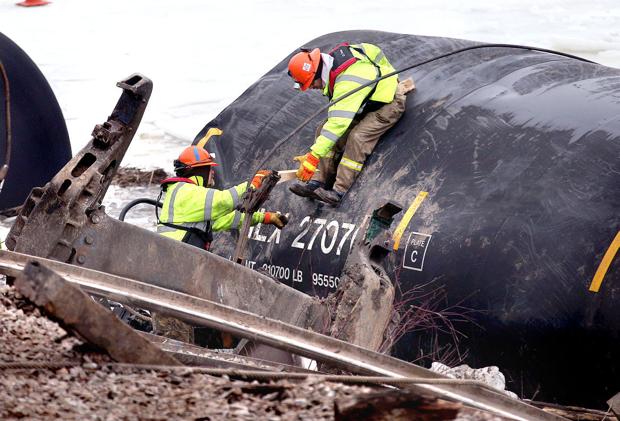
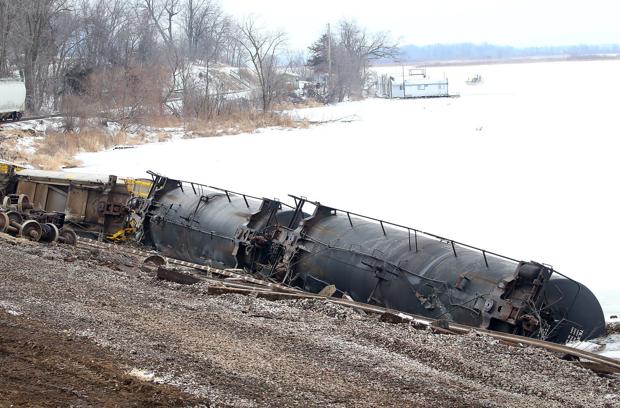
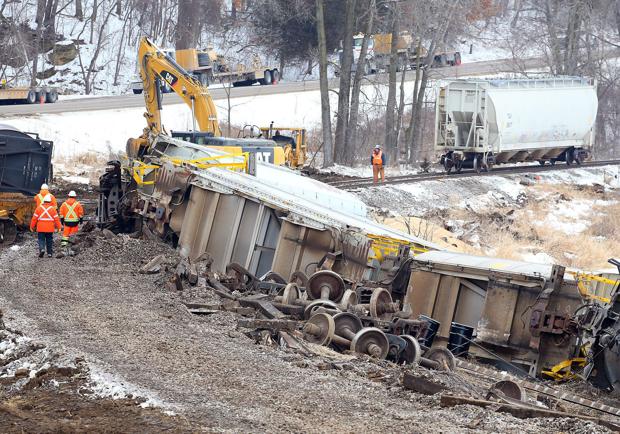
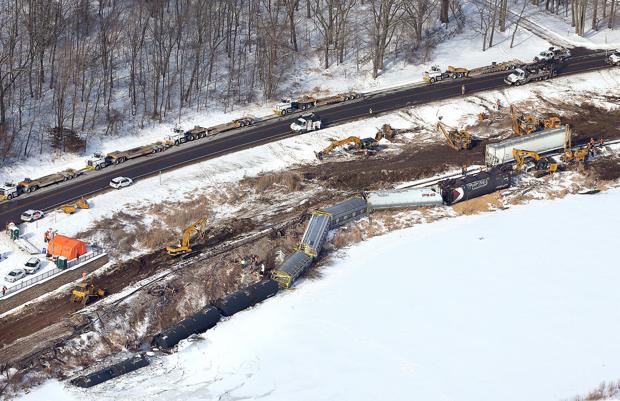
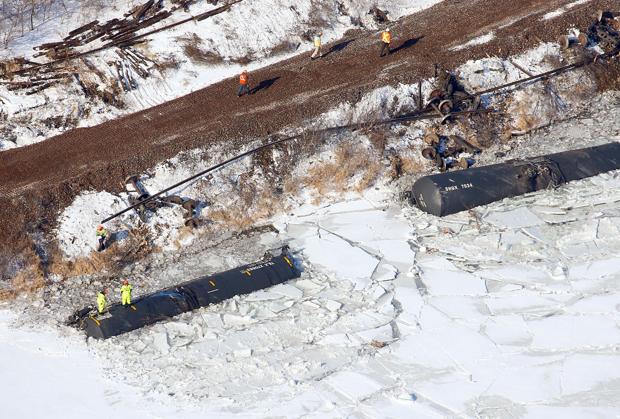
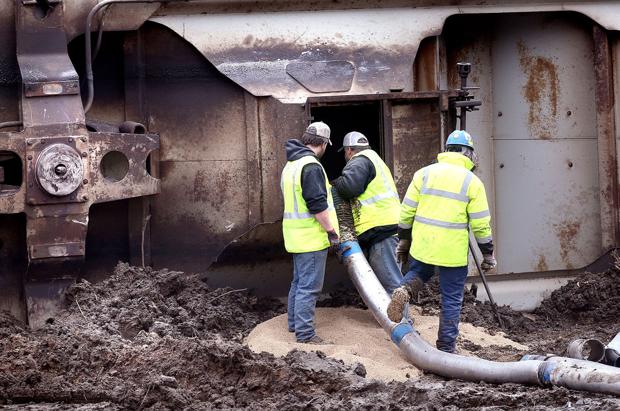
Workers empty the contents of a freight car Thursday as the cleanup continued after a Canadian Pacific train derailed late Tuesday in Houston County, Minn., sending parts of the train into the frozen Mississippi River.


As cleanup of a derailment south of Brownsville, Minn., continued for a third day, questions remained about whether the Canadian Pacific freight train was hauling crude oil, ethanol or other dangerous materials.

The 68-car train was en route from St. Paul, Minn., to Kansas City when 15 cars left the tracks Tuesdaynight, sending six tank cars and about 850 gallons of vegetable oil into the Mississippi River.

Three of the 15 cars that left the tracks were carrying sodium chlorate, a strong oxidizing agent that poses significant health and safety issues when being loaded and unloaded, according to the Environmental Protection Agency.

A small amount of the material spilled, though there was not what the EPA calls a “critical breach” and no sodium chlorate has been detected in the river, according to the U.S. Fish and Wildlife Service.

Canadian Pacific has not provided a list of what other cargo the train was hauling.

Spokesman Andy Cummings said Friday that other products on board included scrap metal, malt and flour but cited “security reasons” for not disclosing any other dangerous goods that may have been present.

Cummings said CP shares details of hazardous materials “confidentially” with first responders.

A spokeswoman for the EPA said she did not know whether the railroad had provided a manifest to the agency, which is one of several monitoring the cleanup.

Phillippa Cannon referred questions about the train contents to the railroad.

A Federal Railroad Administration spokesman would only say that the incident is under investigation.

Railroads have come under increased scrutiny in recent years with the rapid growth of crude oil shipments. A CP train carrying crude oil derailed Nov. 8 in Watertown, Wis., one day after a BNSF train derailed near Alma, Wis., spilling up to 20,000 gallons of ethanol into the Mississippi River. It was the 10th North American derailment of 2015 involving oil or ethanol, according to the McClatchy news service.

According to the latest available reports, about nine trains per week run on the CP line through Houston and La Crosse counties, carrying more than a million gallons of crude. CP reported less than one train per week on the line where Tuesday’s derailment occurred.

Citizens Acting for Rail Safety said that while Tuesday’s derailment did not result in a major release of hazardous material, it “brings to light the potential for serious accidents that can cause disastrous consequences to our communities and environment.” The rail safety group noted that hazardous materials besides oil and ethanol traverse the area daily.

Cummings said CP is required by law to accept all shipments that meet federal standards and the railroad carries a wide variety of goods, including hazardous materials.

“We take our responsibility for safe handling of these materials very seriously,” he said. “Railroads are the safest way to move goods over land. When an incident does occur, we have personnel on staff with the training and expertise to respond to an incident involving any product that we handle.”

Cleanup continues

Cleanup was expected to continue into the weekend as workers unloaded the overturned tankers and awaited a specialty contractor to handle the sodium chlorate.

The railroad reopened the line running south from La Crescent into Iowa around 4:30 a.m. Thursday, a little more than 30 hours after the derailment.

Railroad contractors believed Thursday they had contained the leaking oil and unloaded three tanker. They planned to unload the remaining three Friday. Barriers were placed in the river to contain any oil that made it into the river.

Though it’s not considered a hazardous material, vegetable oil can coat aquatic animals and prevent them from absorbing oxygen, said Sabrina Chandler, refuge manager for the Upper Mississippi River National Wildlife and Fish Refuge.

Chandler said no visible impacts to wildlife had been detected as of Friday.

Three 55-gallon drums of spilled sodium chlorate were recovered from the site. According to the EPA the railroad is awaiting a contractor from Manitoba, Canada, to unload the remaining cars with specialized equipment to prevent the release of dust.